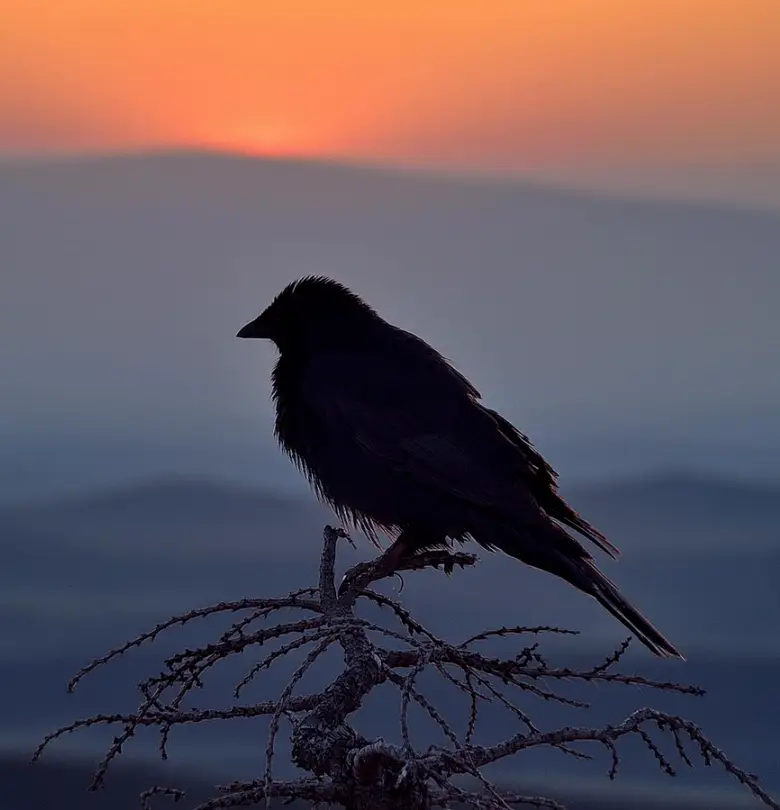
As the red of sunset spread across the highland plateau, I moved through the cooling air with my camera, looking for something to catch — a flutter, a shadow, any sign of life in all that stillness. Then I saw it: a small bird, alone on a thin branch, rocking gently in the breeze. Its feathers trembled against a sky burning gold and crimson, a silhouette balanced between the day's last light and whatever came after.
I pressed the shutter. Then I walked slowly toward it.
As the distance between us shrank, the bird didn't move. Most birds would have lifted off long before I got that close — but this one stayed. When I was finally near enough to see clearly, I noticed a nest tucked into the branch just beside it. That changed everything. The bird wasn't simply perched there; it was holding its ground. There was something in its stillness, something in the sounds it made — sounds I couldn't translate — that felt like a message I wasn't equipped to receive.
The next day, and the day after that, I kept coming back to the same spot. The bird was always there, at the very tip of the same branch, waiting. Even when the gold faded and darkness settled over the plateau, it didn't leave. It simply stayed, as though leaving would mean admitting something it wasn't ready to admit.
I began to construct a story in my mind — the way you do when you witness grief you can't quite name. Perhaps this was a mother. Perhaps she had returned to the nest and found it empty. Perhaps a predator had come while she was gone, or a storm, or simple bad luck — the kind that doesn't ask permission. She couldn't weep the way we do. But the sounds she made, the way she held herself, the small tremors that moved through her body — all of it felt like mourning in its most essential form, stripped of language, stripped of ceremony, stripped of everything except the unbearable fact of absence.
Every morning she was there. Every evening she was there. And I began to feel that her waiting was eroding something inside her — that grief, when it has nowhere to go, eventually turns inward. The sounds she made grew quieter. Her movements grew slower. The brightness that had been in her eyes when I first saw her — that sharp, watchful light — was dimming.
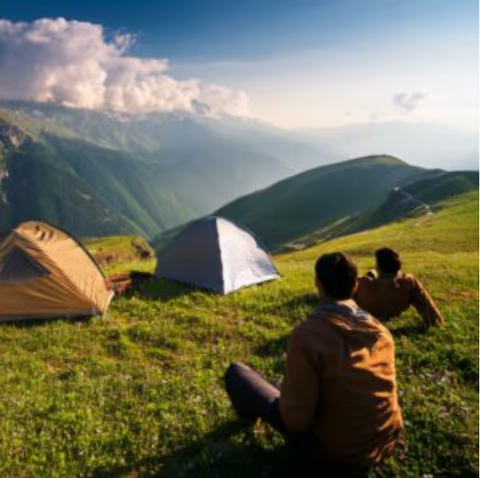
There are moments when you stand in front of another creature's suffering and feel entirely useless. This was one of them. She looked at me — or seemed to — with eyes that were still open but already somewhere far away, and I understood that she was in her final hours. I walked back to my tent that evening carrying a heaviness I couldn't put down.
I went to her first thing in the morning.
The wind was moving softly through dry leaves. The first light of the sun had just reached the trees. She was still on the branch — but her eyes, which had tried so hard to find me one last time, had gone still. Whatever fire had kept her there, waiting, had finally gone out. She was gone — not fled, not frightened away, but simply released. Perhaps, as I chose to believe in that moment, she had found her way back to the one she had been waiting for.
The plateau was very quiet that morning. Another solitary bird on the tip of a branch — except this one was still now, finally unburdened. The silence left behind in the nest was the last echo of her story.
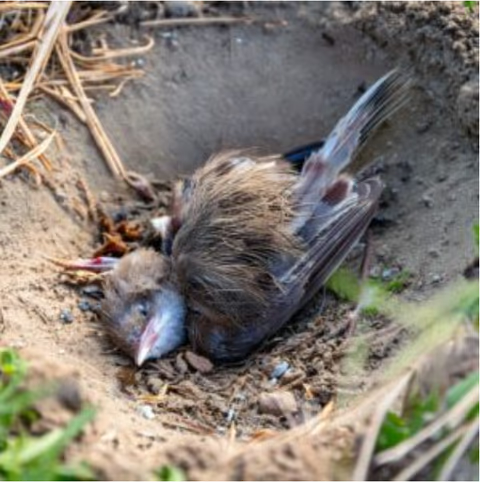
I decided I couldn't simply walk away. I lifted her carefully from the branch — gently, the way you handle something that deserves to be handled gently — and found a peaceful corner of the plateau where the light came through well. I buried her there, nest and all. My tears hit the soil before I finished. I stayed for a moment longer than I needed to, not praying exactly, but hoping in that wordless way that sometimes feels like the same thing.
What I took away from those days is harder to summarise than I expected.
I think what I understood — really understood, not just intellectually but in the bones — is that nature holds stories we are not the protagonists of, and that our willingness to slow down and witness them is one of the more quietly radical things we can do. The grief in that bird's eyes asked nothing of me. It didn't need my interpretation or my pity. But it did something to me anyway. It cracked something open.
Every living creature carries a world within it. Every sound made and not made, every moment of holding on and finally letting go — these are not background details to human life. They are part of the same fabric. Protecting the spaces where animals can live, grieve, and raise their young isn't charity. It's a recognition that we are not the only ones here who feel things that matter.
In a world that moves as fast as ours does, learning to hear what is being said without words — and to let it land — is not a luxury. It is, I think, one of the most human things we can still choose to do.