This isn’t one of those familiar, comforting laments about digitalization. Let’s skip the “technology has isolated us” rhetoric and those safe, boring clichés. The algorithm is already calculating your boredom factor as you read these lines. You can prove the statistics right and close the tab immediately.
But if you stay, we’ll examine the corpse on the table.
That incorrigible digital pragmatist inside you is probably muttering: “Come on, man, what’s the big deal? I’m getting a flawless service that delivers what I need to my doorstep before I even think of it, and solves my problem in 12 seconds with zero errors. I’m free from decision fatigue. Let’s just leave it at that—everything’s running like clockwork.”
Not bad. Just a very quiet, very smooth form of suicide.
Let’s not beat around the bush; perfection is a guarantee of oblivion. The brain doesn’t register smoothness. Where in your memory will you etch that magnificent process—completed in 12 seconds with zero friction? Nowhere. When you receive a flawless service, you don’t experience that moment—you simply consume it and erase it. That sterile flow you call “perfect service” strips you of your agency, turning you into hacked biochemical algorithms. That product thrust in front of you before you even know what you want isn’t your choice at all. It’s a decision the system makes on your behalf. It’s comfortable, yes, but the price of that comfort is the surrender of your will (Knijnenburg et al.:2012).
Here, your mind generates that dangerous—and actually quite legitimate—objection: “Isn’t the being we call a human ultimately just a chemical algorithm? Don’t we make our decisions by looking at our experiences, our genetics—in other words, our own data? So why resist a silicon-based algorithm that works faster and more flawlessly?” (Gao & Mvondo: 2026).
A brilliant question. And the greatest fallacy—that false divine arrogance of believing a machine can simulate the universe—begins precisely here.
Yes, we have the codes of our biology. But the machine calculates and implements the most efficient, most logical, and safest path. Yet humans are the only living beings who, even though they know the most efficient path very well, can reject that logical calculation with a wave of the hand and walk up a steep hill for the sake of a truth they simply believe in, an unshakable truth. Silicon doesn’t make mistakes; if it does, it crashes. Humans make mistakes, suffer, and transcend their limits. While an algorithm codes this disruptive defiance as an “error” or “foolishness,” we call it character.
A machine mimics action, processes data, and defines intent like a dictionary, but it cannot “embrace” that intent. It measures the intensity of the breath blown into the fire, but it cannot know why you stoked that fire. Was it to heat the house, or to reduce that house and its inhabitants to ashes? There is action in the machine, but there is no ontological weight, no responsibility, and no guilt attached to that action. What distinguishes humans from machines is not the ability to calculate, but the audacity to take on responsibility and then tear up that calculation. I can almost hear your next objection: “Nice philosophy. But you can’t manage a global company, a massive logistics operation, or an organization employing thousands of people with ‘emotion and imperfection.’ As scale increases, optimization becomes the sole condition for survival.”
Is that so? Take another look at Dentsu’s 2025 data. Saying, “I provide flawless, frictionless service” is, in business terms, the same as saying, “I’ve become an instantly replicable, ordinary commodity.” When you offer the customer zero friction, you eliminate that human connection, that face-to-face interaction at the table. While you boast about solving the operation in 12 seconds, tomorrow another software will do the same job in 11 seconds—and that customer you trusted so much will ditch you with a single click. That 14% brand loyalty in the table is exactly this. Smoothness kills the brand. (Dentsu:2025)
Table 1: Inverse Correlation Between Touchpoints and Brand Loyalty

Trade was not merely an exchange of goods. It was the building of trust. The haggling, that glance, that hesitation… All were proof of our existence. When you eliminate friction, you don’t eliminate delay—you destroy the very space where the bond is tested. If you seek perfection, morgues are very quiet and utterly smooth. Living things make mistakes, sweat, tire, and leave traces.
You cannot speed up the system by turning the worker, the teacher, or the doctor into a breathing Excel cell (Buhalis & Law: 2024). Those pauses that the machine perceives as “inefficient gaps” and tries to eliminate are actually the biological safety valves necessary for problem-solving, meaning-making, and survival (Shekhar & Saurombe: 2026).
So What’s the Outcome? What Will We Do?
You’ve read all this. But tomorrow morning, you’ll still have the AI do that 5-hour operational drudgery in 2 minutes. You’ll still use algorithms.
Of course, we won’t unplug and retreat to a cave. No one is telling you to reject gunpowder. The issue isn’t about not using gunpowder. The problem is surrendering to the sterile civilization that technology has built and becoming alienated from our own will.
Use the machine. But don’t hand over the reins—don’t give it the final say. Automate the drudgery, but don’t automate will, nature, and that genetic stubbornness. Let the algorithm be your tool; don’t let yourself become its parameter.
How? In the business world, in the office, at the hospital, or at that interview table:
This isn’t about deliberately doing the wrong thing (foolishness); it’s about defying optimization. When hiring a talent, lay out that sterile, predictable profile that HR algorithms deem 99% compatible. Then set it aside and hire the talent the algorithm deems “risky”—the one with that unsettling spark in their eyes, the flawed talent capable of shaking up the system. Bring in the character that optimization has weeded out.
Don’t fully automate your interactions with your customers or employees and turn into a ghost. Perfect the backend of your logistics network, yes; but embed a jarring “human imperfection”—one that reeks of lived experience—into the very “moment” the package is delivered—something a machine could never replicate (Grewal et al.: 2020).
Reject safe averages. If a strategic decision your company makes or a business model you establish can be easily predicted and generated by an AI, then you are no longer a subject but merely a parameter that has already been phased out in the face of that absolute authority (Xu et al.: 2024).
The future belongs not to the docile masses who process data most efficiently and operate most smoothly, but to those who plant humanity’s unshakable stubbornness like a flag atop the system.
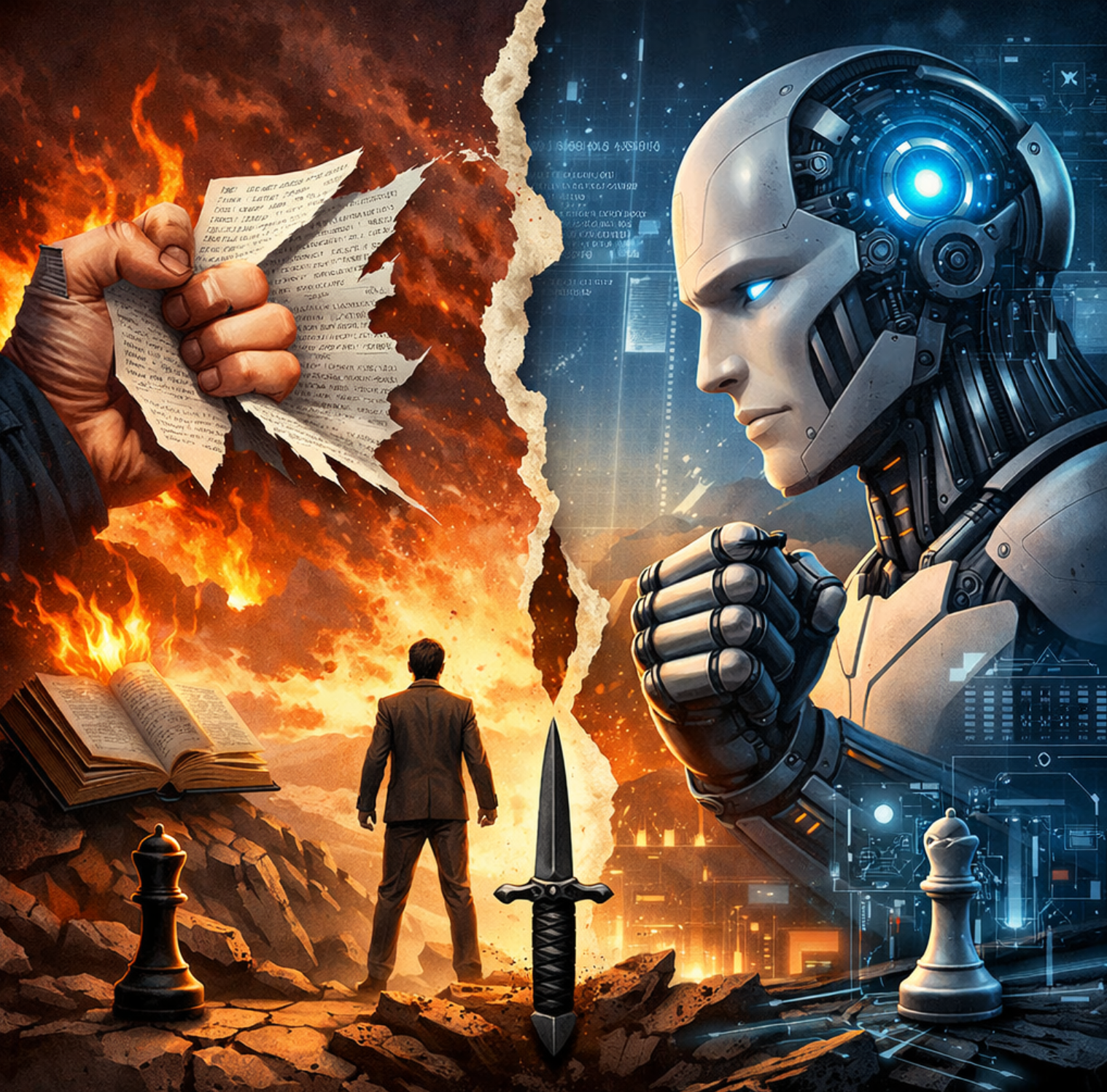
Will you be a passive object whose pages of actions and decisions are turned by algorithms, or the author who rips that book in half and throws it away? If what the algorithm finds when it locates you is merely the statistical average of your past, then your soul is already waiting its turn in that digital morgue (Lai: 2026).
A human being is not a probability distribution. And that excess of information is our freedom—the one code no algorithm can ever decipher (Tegmark: 2024).
The choice is yours. Will you be a parameter, or a dagger plunged into the heart of the universe?
Sources
Buhalis, D., & Law, R. (2024). Digital Taylorism 2.0: AI-mediated performance control. Tourism Management.
Dentsu. (2025). Human Truths in the Algorithmic Era: 2026 Media Trends.
Gao, L., & Mvondo, G. F. N. (2026). Rethinking personhood and agency: How AI challenges human-centered concepts. Frontiers in Psychology, 16.
Grewal, D., et al. (2020). The future of technology and marketing: A multidisciplinary perspective. Journal of the Academy of Marketing Science, 48(1).
Knijnenburg, B. P., et al. (2012). Explaining the user experience of recommender systems. User Modeling and User-Adapted Interaction, 22.
Lai, H. (2026). “Please, don’t kill the only model that still feels human”: Understanding the #Keep4o Backlash. arXiv:2602.00773.
Shekhar, A., & Saurombe, M. D. (2026). Algorithmic anxiety: AI, work, and the evolving psychological contract in digital discourse. Frontiers in Psychology, 17.
Tegmark, M. (2024). The Mathematical Universe: Computational irreducibility of consciousness. MIT/arXiv.
Xu, Y., et al. (2024). Sustainable Co-Production and Algorithmic Control: A Techno-Economic Assessment. Sustainability, 16(4).